.svg)


Why Automated Testing Is a Smart Choice
The pace of innovation in enterprise software is accelerating rapidly. Vendors are releasing new features, security patches, and functional improvements at a frequency that was unthinkable only a few years ago. This trend is especially pronounced in SAP cloud solutions, where quarterly, monthly, or even continuous updates are now the norm.
As release cycles shorten, the traditional approach of manual testing becomes increasingly unsustainable. Manual regression testing is time-consuming, error-prone, and difficult to scale. Automated testing, by contrast, allows organizations to validate business-critical processes quickly and consistently after every change.
Beyond speed, automated testing provides several additional advantages:
- Risk reduction: Automated regression tests help ensure that core business processes continue to function correctly after upgrades or configuration changes.
- Cost efficiency: While there is an upfront investment, automation significantly reduces long-term testing effort and rework caused by late defect detection.
- Improved quality: Consistent, repeatable tests reduce human error and increase overall system reliability.
- Business enablement: Faster and more reliable testing enables organizations to adopt innovations sooner, rather than delaying upgrades due to testing concerns.
In short, as SAP landscapes evolve more frequently, automated testing is no longer optional—it is a strategic necessity.
What Tools Are Recommended for SAP Customers
The choice of test automation tools for SAP customers depends primarily on the type of SAP backend in use. SAP distinguishes between public cloud and private cloud / on-premise deployment models, and this distinction has a direct impact on tool suitability.
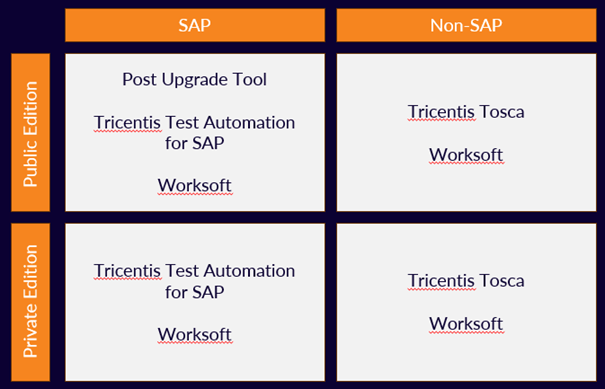
In simplified terms:
- SAP Public Cloud environments typically rely on SAP-supported or SAP-aligned testing tools, such as SAP’s Post Upgrade Test (PUT) tools, Tricentis Test Automation for SAP, and selected third-party solutions.
- SAP Private Cloud and on-premise systems offer greater flexibility and therefore support a broader range of enterprise-grade test automation platforms.
In addition, some tools focus exclusively on SAP, while others support both SAP and non-SAP applications, enabling true end-to-end business process testing across heterogeneous landscapes. Selecting the right tool requires balancing SAP compatibility, system architecture, and broader testing strategy.
What You Need to Know About Tricentis
Tricentis is a well-established name in the test automation market and has a strong footprint in SAP environments. Its SAP-focused offerings are designed to support regression testing for SAP GUI, web-based SAP applications, and selected SAP cloud solutions.
Key characteristics of Tricentis include:
- Model-based test automation, which reduces script maintenance by abstracting technical details.
- Strong SAP integration, including support for SAP GUI, Fiori, and related technologies.
- Enterprise focus, making it particularly suitable for large organizations with complex testing requirements.
However, Tricentis solutions often require a structured implementation approach and dedicated expertise. Licensing models and operational complexity may be less attractive for smaller or mid-sized organizations without a mature test automation practice.
What You Need to Know About Worksoft
Worksoft is purpose-built for business process testing in ERP-centric environments, with SAP as its primary focus. The platform emphasizes usability and business alignment, enabling both IT and business users to participate in test creation and maintenance.
Key strengths of Worksoft include:
- Business-process-driven automation, allowing tests to reflect real end-to-end workflows rather than isolated technical steps.
- Codeless test creation, lowering the barrier to entry and reducing dependency on specialized automation engineers.
- Broad SAP coverage, including SAP ECC, S/4HANA, Fiori, and integrations with non-SAP systems.
- Rapid time to value, with faster onboarding and quicker realization of benefits compared to more complex platforms.
Worksoft is particularly well suited to organizations that want to scale automation pragmatically while keeping ownership close to the business.
Our Recommendations
For mid-sized SAP customers, Worksoft is often the optimal choice. Based on our experience, it offers the best balance across several critical dimensions:
- User experience: An intuitive interface allows business users to contribute meaningfully to testing activities.
- Ease of use: Codeless automation reduces implementation effort and ongoing maintenance.
- Commercial flexibility: Licensing models are generally more accessible and adaptable to mid-sized organizations.
While Tricentis remains a strong option for very large enterprises with highly complex landscapes, Worksoft typically delivers faster results and a lower total cost of ownership for mid-sized customers.
Your Next Step
Choosing the right test automation strategy is a critical decision, and every SAP landscape is different. If you have questions, e.g. integration with SAP Cloud ALM, want to discuss your specific environment, or would like to see the tools in action, we are happy to help.